
Commercial Metal Roofing
The Property Manager’s Guide to Commercial Metal Roofing: Protecting Assets
As a commercial property manager overseeing assets in the heart of Tornado Alley and the Great Plains, your buildings face some of the most volatile weather on the planet. From baseball-sized hail in Oklahoma and straight-line winds in Kansas to heavy snow loads in Missouri and scorching triple-digit summer heat in Texas, the building envelope is under constant assault.
For property management companies balancing capital expenditure (CapEx) budgets against long-term asset value, selecting the right roofing system is critical to maximizing Net Operating Income (NOI).
While single-ply membranes are common, commercial metal roofing has emerged as the premier strategic choice for industrial warehouses, retail centers, and office complexes across these four states. Here is why installing a commercial metal roof is one of the smartest long-term investments you can make for your portfolio.
The Severe Weather Reality: Why the Central U.S. Demands Metal
Commercial buildings in the central and southern plains face severe environmental conditions that rapidly degrade standard roofing materials:
Extreme Hail and Convective Storms: According to recent insurance data, hail and severe convective storms generate billions in roof-related claims across Texas, Oklahoma, and the Midwest. Traditional roofs puncture, but a high-performance steel roof holds strong.
Aggressive Wind Uplift: Flat roofs often suffer from edge failure during high-wind events. Metal roofing panels—specifically standing seam systems—are engineered to withstand wind speeds exceeding 140 mph.
Rapid Thermal Cycling: Temperature swings in this region are brutal. A roof can experience a 50°F drop in just a few hours when a cold front slams into Texas or Oklahoma, causing massive structural expansion and contraction that splits weaker membranes.
Key Benefits of Commercial Metal Roofing for Property Management Portfolios
1. Unmatched Longevity and Lifecycle Cost Advantages
While the initial upfront cost of a commercial metal roof is higher than single-ply options like TPO or modified bitumen, its lifespan is unmatched. A properly installed architectural metal roof can easily last 40 to 70+ years.
When evaluated via a lifecycle cost analysis, metal roofs are significantly cheaper over time because they completely eliminate the need for a costly tear-off and replacement every 15 to 20 years. For property managers looking to stabilize long-term capital forecasting, this permanence is a game-changer.
2. Maximum Storm Resilience and Class 4 Impact Ratings
To combat the unrelenting severe weather in Oklahoma, Kansas, Missouri, and Texas, commercial metal roofs are typically rated with a UL 2218 Class 4 Impact Resistance. This means the panels can withstand severe hail strikes without rupturing or losing structural integrity.
Property Management Tip: Installing a Class 4 rated commercial metal roof can often qualify your building for substantial discounts on commercial property insurance premiums, directly lowering operating expenses.
3. Energy Efficiency and Lower Utility Overhead
Metal is naturally conductive, but modern commercial metal roofing utilizes highly reflective, specialized cool-roof coatings (such as Galvalume or Kynar 500 finishes). These coatings reflect up to 70% of solar radiation away from the building.
In sun-drenched states like Texas and Oklahoma, this dramatically lowers summer cooling loads. For buildings operating under gross leases, these utility savings flow directly back into your bottom line. For triple-net (NNN) leases, it enhances tenant retention by lowering their operational overhead.
4. Low Maintenance and High Structural Dependability
Compared to low-slope flat roofs that are prone to clogged drains, ponding water, and seam failures, metal roofs require remarkably low maintenance. They shed water, ice, and debris naturally.
Routine maintenance generally consists of an annual inspection to check fasteners, sealants at penetrations, and flashing details, allowing property management teams to allocate labor and capital elsewhere.
Standing Seam vs. Screw-Down (Exposed Fastener) Metal Panels
When evaluating options with a commercial roofing contractor, you will generally choose between two primary profiles:
Feature | Standing Seam Metal Roof | Screw-Down (Exposed Fastener) |
Fastener Design | Concealed clips; highly watertight | Screws pierce the metal panels |
Thermal Movement | Excellent (Panels expand/contract freely) | Limited (Can cause holes to widen over time) |
Lifespan | 50+ Years | 20–30 Years |
Best Used For | Class-A Office, Retail, High-Value Industrial | Agricultural, Budget Warehouses, Sheds |
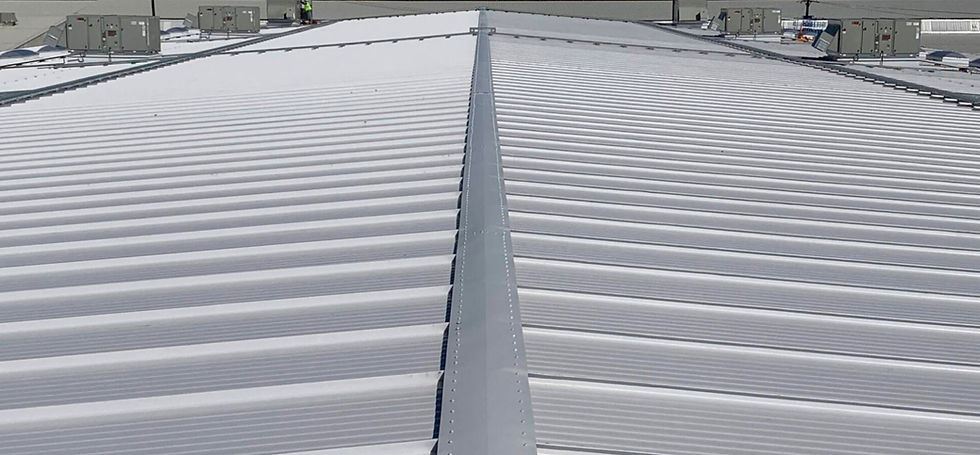
For most commercial property managers, standing seam metal roofing is preferred because concealing the fasteners inside the interlocking seams eliminates the number one cause of roof leaks: backed-out screws.
Frequently Asked Questions (FAQ)
Can you install a commercial metal roof over an existing roof?
Yes! In many areas across the Midwest and South, a metal roof retrofit (or recover) can be installed directly over an existing single-ply or asphalt roof, provided the underlying deck is structurally sound and dry. This eliminates demolition labor and landfill disposal fees, saving your company thousands on installation costs.
How does a metal roof handle the heavy snows of Missouri and Kansas?
Metal roofs are excellent for snow accumulation. Their slick surface and uniform heat distribution allow snow to slide off naturally, preventing dangerous snow loads and ice dams from forming on the edges of your facility.
Is a commercial metal roof noisy during rain or hailstorms?
This is a common myth. In commercial applications, metal roofing is installed over solid substrates, dense insulation boards, and acoustic ceilings. The dampening effect of these components ensures that interior noise levels are no different than those of a standard TPO or built-up roof.
Protect Your Real Estate Assets for the Next Half-Century
Investing in a high-quality commercial metal roof across Oklahoma, Kansas, Missouri, or Texas is more than a structural upgrade—it is a defensive asset management strategy. By insulating your properties against catastrophic storm damage, dropping utility costs, and securing lower insurance premiums, you directly protect your tenants and maximize property valuation.
Ready to future-proof your commercial facility? Contact a certified commercial roofing contractor specializing in metal systems in your area today to request a comprehensive code compliance review and structural evaluation.
Intent & Regional Search Insights
What are the benefits of commercial metal roofing? Extreme weather durability (hail/wind), a 50+ year lifespan, superior energy efficiency, low maintenance, and potential insurance premium discounts.
Best commercial roof for hail protection: Class 4 impact-rated standing seam metal roofs provide the highest degree of protection against severe convective storms and large hail.
The benefits of out manufacture certified installation crews: Ensure you partner with a licensed, insured roofing contractor holding manufacturer certifications to guarantee long-term material and labor weather-tight warranties.


Comments